
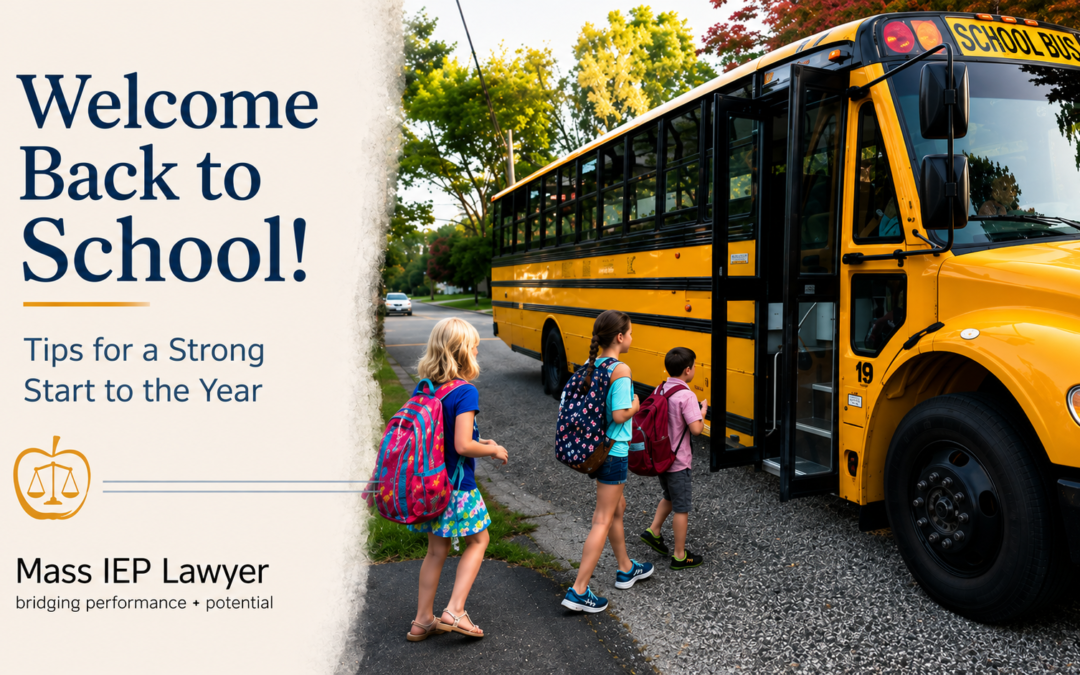
The school year is officially underway — and if your inbox already feels full, you are not alone. These back to school IEP tips are designed to help families of students with disabilities navigate the first weeks with more confidence. Getting your footing early can make a real difference if challenges come up later.
The first few weeks bring new teachers, new schedules, and new expectations. For families of students with IEPs, they also bring important questions. Who are the service providers? Where and when are services being delivered? What supports are in place? Getting answers to these questions now is well worth the effort.
Give Your Child Time to Adjust — But Watch for Patterns
A difficult first day does not mean a placement is wrong. Transitions are hard. It often takes time for students to settle into new routines.
At the same time, parents know their children. If you see persistent anxiety, school refusal, or frequent meltdowns beyond the first couple of weeks, take note. Do not simply assume your child needs to “get used to it.”
Instead, look for patterns. What is happening? When does it happen? How often? Is there a specific class, setting, or time of day that seems to trigger the difficulty? Those observations can be very important down the road.
Review Your Child’s IEP and Schedule
The start of the school year is a good time to pull out your child’s IEP and read it with fresh eyes. Do you know what services your child is supposed to receive? How frequently? In what setting?
Also review what accommodations are listed. Are there supports for transitions, communication, behavior, executive functioning, or social-emotional needs? If you cannot answer those questions clearly, ask.
Consider requesting a copy of your child’s weekly schedule. If your school uses a rotating cycle, ask for the full cycle. The schedule should show you when and where each special education and related service is being delivered. This helps you confirm that the IEP is being implemented as written.
Establish a Home-School Communication System Early
If your child has complex needs, proactive communication between home and school is essential. Consider setting up a shared Google Doc or another agreed-upon method at the beginning of the year.
The goal is not to create more work for anyone. Instead, it is to prevent important information from being scattered across emails, phone calls, and hallway conversations at pickup.
Talk with the school about what will be communicated, by whom, and how often. For example, you might agree that significant incidents — missed services, behavioral issues, injuries, or toileting accidents — will be logged in the shared document. Routine questions can then be handled by email. There is no single right system. The important thing is that everyone understands the expectations.
Be Specific About What Information You Need
“Let us know how he is doing” can mean very different things to different people. If you have concerns, think carefully about what information would actually help you.
For instance, if your child is working on staying in the classroom, you may want to know how often they leave, how long they are gone, and what support helped them return. If social skills are a focus, ask about the types of interactions they are having and the level of adult support required.
Similarly, if toileting is a concern, ask whether scheduled bathroom breaks are happening and what assistance is being provided. In general, the more specific your question, the more useful the answer will be.
Communicate Concerns Early — Do Not Wait
You do not need to wait for a problem to become a crisis before speaking up. If you notice a concern, raise it. If the school identifies a concern, ask questions. If a strategy is put in place, ask how you will know whether it is working.
Communication should go both ways. Parents can share what they are seeing at home. Teachers and service providers can share what they are observing at school. Together, that picture is much more complete.
The goal is not to resolve every issue immediately. Rather, it is to make sure concerns are identified before they grow into bigger problems.
Trust Your Instincts and Know Your Rights
You know your child better than anyone. That does not mean every concern points to something the school is doing wrong. It does mean that persistent concerns deserve to be taken seriously.
If something does not feel right, gather information. Review the IEP. Communicate with the school. And when appropriate, ask the IEP Team to reconvene. Under the Individuals with Disabilities Education Act (IDEA), parents have the right to request an IEP meeting at any time. You do not have to wait for the annual review.
The first weeks of school are not just about getting through the transition. They are an opportunity to learn how your child’s program is working in practice — and to course-correct early if it is not.
Back to School IEP Questions? We Can Help.
If you have concerns about your child’s IEP or special education rights in Massachusetts, Contact me to schedule a consultation.
Welcome back — here’s to a productive, positive year ahead.