
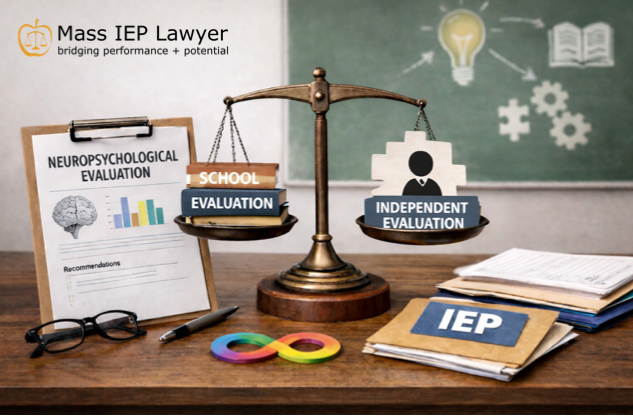
Why the Right Evaluation Can Change the Quality of Every Decision Being Made About Your Child’s Education
If you’re navigating the IEP process, you already know the stakes. You’re trying to make sense of a lot of information—and figure out what will actually help your child.
A neuropsychological evaluation can be one of the most powerful tools in that process. More importantly, it can fundamentally change the quality of the decisions being made about your child’s education.
What Is a Neuropsych Eval?
A neuropsychological evaluation is a comprehensive assessment conducted by a licensed neuropsychologist. It typically includes several hours of one-on-one testing, parent and teacher input, and a detailed review of your child’s developmental and educational history.
Unlike most school-based evaluations, a neuropsych goes deeper. It looks at how your child learns across areas like attention, memory, language, processing speed, executive functioning, and academic skills.
The end result is not just a set of scores, but a detailed written report—and most importantly, specific, evidence-based recommendations.
Why It Matters for the IEP Process
An IEP is only as good as the information it’s built on.
School evaluations often tell you what your child is struggling with. A neuropsychological evaluation helps explain why. That distinction matters—because without understanding the “why,” it is very difficult to design appropriate goals, services, and supports.
Here’s how a neuropsych can change the process:
An independent perspective. The evaluation is conducted outside of the school district, which means the findings are not influenced by district resources, programming, or internal decision-making.
Needs the school may miss. Neuropsych evaluations often uncover underlying issues—like weaknesses in working memory, processing speed, or language processing—as well as co-occurring diagnoses that may not be captured in school testing.
Credibility and leverage in IEP meetings. A comprehensive, data-driven report from a reputable neuropsychologist carries weight. It shifts conversations from opinions to evidence and gives you a stronger foundation to advocate for appropriate services.
Meaningful, specific recommendations. Instead of generic supports, a strong neuropsych report provides targeted recommendations for instruction, services, and accommodations that are directly tied to your child’s learning profile.
Strengthening Your Position in Disputes
When there is disagreement with the school—whether about eligibility, services, or progress—a neuropsychological evaluation becomes even more important.
It creates a clear, independent record of your child’s needs and can highlight when the current program is not appropriately addressing them or supporting meaningful progress. It also puts the district on notice of those needs and the recommendations required to address them.
In practice, this often changes the dynamic: the conversation is no longer about whether your child needs support, but whether the proposed IEP is actually designed to meet those needs.
What Actually Changes When You Have a Neuropsych
The difference isn’t just more data—it’s better decision-making.
Without a neuropsychological evaluation, IEP discussions tend to stay at the surface level: identifying that a student is struggling, then matching that struggle to general supports or standard accommodations.
With a neuropsychological evaluation, the conversation shifts. Instead of asking “What should we try?” the team can ask “What does this child actually need, based on how they learn?”
That shift shows up in important ways:
- Conversations move from general concerns to specific, evidence-based needs
- Recommendations are tied to your child’s cognitive profile, not just grade-level expectations
- Underlying and overlapping issues are identified, rather than missed
- Parents are positioned to question, refine, and advocate for what’s being proposed
In other words, the IEP becomes more intentional, more individualized, and more likely to appropriately address your child’s needs.
The Bottom Line
A neuropsychological evaluation is not just a set of test scores—it is a tool for understanding your child and holding the IEP process to a higher standard.
It won’t automatically result in more services. But it gives you the clarity, specificity, and independent support needed to advocate effectively—and, when necessary, to challenge decisions that don’t align with your child’s needs.
For families navigating the IEP process, that kind of information can make all the difference.
Not Sure If a Neuropsych Is the Right Next Step?
A neuropsychological evaluation can make a significant difference—but timing matters, and it may not be the right first step.
If you’re unsure how an evaluation fits into your child’s IEP, or how to use one you already have, I can help you think it through.
Let’s talk through what makes sense for your child.
This post is intended for informational purposes only and does not constitute legal advice.