
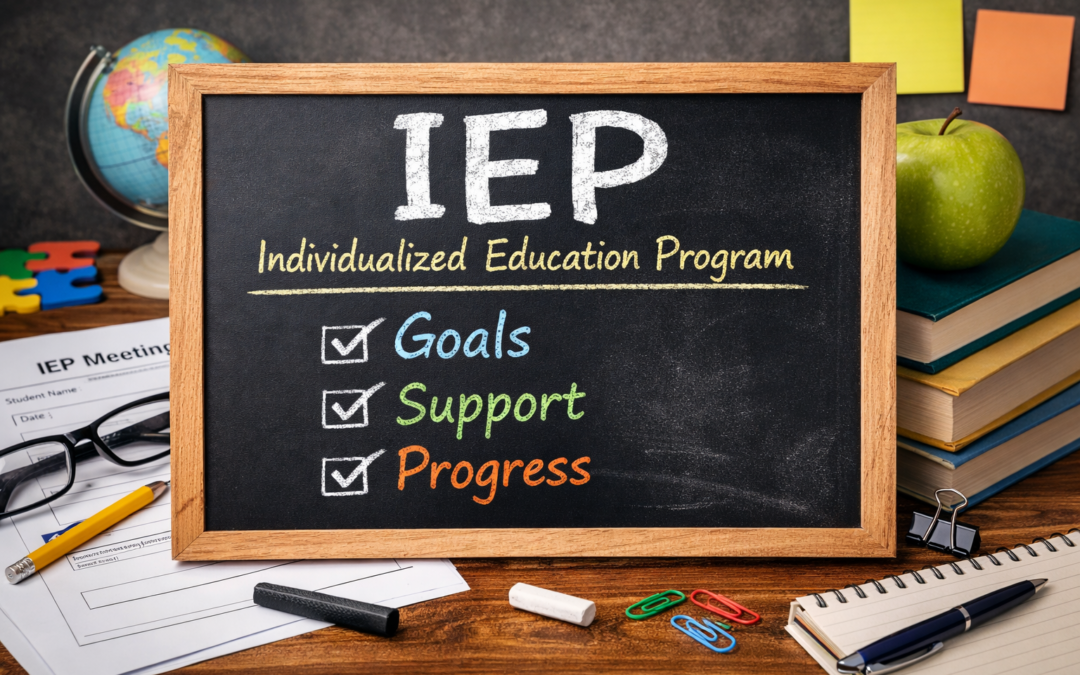
If your child has been recommended for special education services, you’ve probably heard the term “IEP” — but what does it actually mean, and how does it work?
What Is an IEP?
An Individualized Education Program (IEP) is a legally binding document created for students with disabilities who qualify for special education services under the Individuals with Disabilities Education Act (IDEA). It is a personalized roadmap that describes your child’s current performance, the specialized instruction and supports the school will provide, and the goals designed to help your child make meaningful progress.
Who Qualifies?
To receive an IEP, a student must have one of 13 disability categories recognized under the Individuals with Disabilities Education Act (IDEA) — including learning disabilities, autism spectrum disorder, speech/language impairments, and emotional disabilities. The disability must adversely affect the student’s educational performance andrequire specialized instruction and/or related services.
How Is an IEP Developed?
The development of an IEP typically begins with a formal evaluation conducted by the school district with parental consent. These evaluations assess the child’s academic, cognitive, social, and functional needs. If the student is found eligible, an IEP team meets to develop the plan. Parents provide insight about their child’s strengths and challenges, teachers share classroom observations, and specialists such as psychologists or speech-language pathologists contribute evaluation data.
Together, the team develops goals, services, and supports tailored to the student’s needs. Before the IEP can take effect, parents must provide written consent.
What’s Inside an IEP?
Every IEP must include several core components, including:
- the student’s present levels of academic and functional performance
- measurable annual goals
- the special education services and related services the school will provide
- how progress will be measured and reported to parents
- the extent to which the student will participate in general education
The IEP Meeting
Parents are equal members of the IEP team. At least once each year, the team meets to review progress, update goals, and adjust services as needed. Parents also have the right to request a meeting at any time if concerns arise, and they may accept, reject, or partially reject a proposed IEP.
Understanding the IEP process helps parents advocate effectively when their child’s needs are not being met.
This post is intended for informational purposes only and does not constitute legal advice.