
Why Parents Should Rarely Accept a Proposed IEP in Full — and How Partial Rejection Protects Your Child’s Rights
After your child’s IEP meeting ends, many parents feel relieved simply to be done with it. The discussion is over, the decisions seem settled, and the next step feels straightforward: wait for the written IEP and sign it when it arrives.
In Massachusetts, the school provides the written IEP within five school days of the meeting. You are then given 30 calendar days to carefully review what the IEP Team proposed. That is often when the most important part of the process actually begins. In the digital age, it is easy to click “accept in full” in DocuSign and be done with it. However, that would be a grave mistake.
The IEP the school proposes must meet the legal standard of adequacy — but you, as a parent, are not held to that same standard when responding. The school’s obligation is to offer an appropriate education. Your obligation is to your child. That means you can — and should — reject the omission of anything that falls short of what you believe your child needs. Adequacy is the school’s floor. It is not yours.
Accepting an IEP without objection precludes you from later challenging its adequacy — including everything that was left out. Rejecting omissions is how you keep the door open.
“Appropriate” Is a Floor, Not a Ceiling
Under the Individuals with Disabilities Education Act (IDEA), schools must provide a free appropriate public education — not the best possible education, and not the education a child might receive in an ideal world, but one that is reasonably calculated to enable meaningful educational progress.
A proposed IEP can clear that legal bar and still fall short of what your child genuinely needs. Goals can be written to be achievable rather than ambitious. Services can be set at the minimum defensible level. Supports that would make a real difference can simply be absent from the document.
When an IEP meets the legal standard of adequacy but omits things you believe are necessary, accepting it without objection leaves you with no record that you ever asked for more. Rejecting those omissions — specifically and in writing — preserves your ability to pursue them.
Rejecting an IEP Doesn’t Mean Starting Over
Many parents hesitate to reject a proposed IEP because they worry it will blow up the relationship with the school, delay services, or require starting the process from scratch. In most cases, those concerns are misplaced.
When you reject an IEP, your child’s current placement and services continue unchanged while the dispute is resolved. You are not removing your child from the table — you are keeping your seat at it. Rejection is the beginning of a negotiation, not the end of one.
One important exception applies to initial IEPs — the first IEP developed for a child who has never previously received special education services. In that situation, while you may still reject omissions and document your objections, your child cannot begin receiving services until you accept the IEP’s goals, services, and placement in full. Partial rejection that withholds acceptance of any of those core elements will delay the start of services. For initial IEPs, the strategic calculus is different: document everything you believe is missing, but understand that full acceptance of the proposed program is the threshold that opens the door to services.
Partial acceptance is a tool. Accept what genuinely serves your child.
Reject — in writing — everything that falls short or was left out entirely.
You can also accept parts of an IEP while rejecting others. A targeted, specific rejection — “I accept the goals and placement but reject the omission of weekly speech therapy sessions” — is more powerful than a blanket refusal and more strategically useful than blanket acceptance.
What to Look For Before You Respond
When the IEP arrives, review every section not just for what it says, but for what it doesn’t say. Ask yourself: what did I advocate for in this meeting — or in previous meetings — that isn’t reflected here?
Notice, N1, Narrative Description: Did the Team document all areas of agreement and provide cogent explanations for rejections? If the narrative misrepresents what was discussed or omits areas of agreement, your written response is the place to correct the record.
Goals: Are they specific, measurable, and ambitious enough to represent real progress? A goal written to be easily met provides little benefit and generates no useful data. Goals should build skills, not measure the absence of behaviors.
Services: Are the type, frequency, duration, and location of services truly matched to your child’s needs? Is the appropriate personnel providing services? If you requested a service that isn’t listed, that omission must be rejected.
Accommodations and Modifications: Are these concrete and enforceable? “Extended time” is measurable. “Teacher support as needed” is not. Vague language gives the school room to do nothing. Methodologies (e.g., OG, Wilson) are rarely named, but should be defined with enough specificity to be enforceable.
Related Services: Speech, OT, counseling, assistive technology — if your child needs it and it isn’t there, reject the omission explicitly.
Placement: Was the rationale for the proposed placement discussed and documented? If you advocated for a different placement — whether more or less restrictive than what is proposed — reject the offered placement and state your position in writing.
How to Partially Reject: Put It in Writing
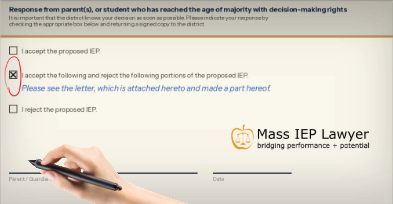
Check the box “I reject the following portions of the IEP.” On the form, note that your detailed objections are attached or being forwarded by email.
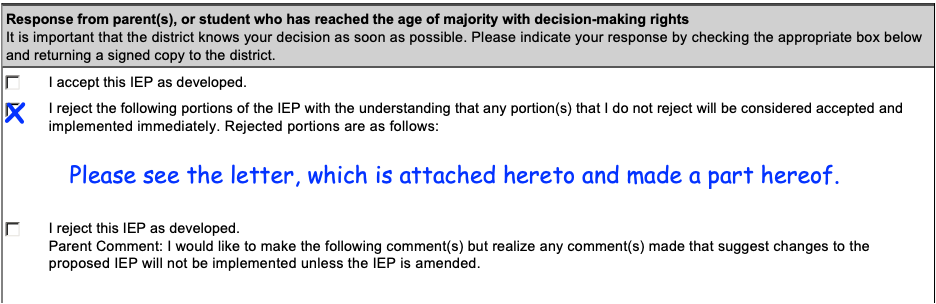
While there is no required format, your rejection should be in writing documented directly on the signature pages provided with the IEP. Be specific. Don’t simply say the IEP is inadequate. If possible, go through the IEP section by section and identify each omission or concern that it is absent from the proposed IEP, and formally reject the IEP on that basis. This creates a documented record that you identified the gap, you objected to it, and the school was on notice.
This record matters enormously if the dispute escalates to mediation, a state complaint, or a due process hearing. A parent who has consistently and specifically rejected IEP omissions in writing is in a fundamentally stronger position than one who accepted each year’s IEP without comment.
When Full Acceptance Is Warranted (Rare!)
There are circumstances where a proposed IEP genuinely reflects everything your child needs — where your input was incorporated, outside evaluations were considered, and nothing meaningful was omitted. In those cases, full acceptance is appropriate and honest.
The goal of this approach is not reflexive rejection. It is informed, deliberate review. Accept what is right. Reject what is missing. Document both. That discipline — applied consistently, year after year — is what real advocacy looks like.
This post is intended for informational purposes only and does not constitute legal advice.